
Skip to content
Menu
905-388-3333

Monday – Friday: 8:00AM – 4:30PM · 24 Hour Emergency Service

A person stretching in a home with clean, fresh air

Air Quality

Whole Home Ventilator Systems

On this page
  1. Benefits of whole-home ventilation
  2. HRV or ERV?
  3. Whole-home ventilator questions

“Good air in, bad air out.” A whole-home ventilator replaces stale indoor air with filtered fresh air from outside, diluting odours, allergens and chemicals, while recovering most of the heat (and, with an ERV, moisture) so you don’t waste energy. It’s especially valuable in newer, tightly built homes.

Get a Ventilator Quote

Benefits of whole-home ventilation

Fresher air

Removes lingering odours, cooking smells and stale air.

Healthier home

Dilutes allergens, bacteria and volatile organic compounds (VOCs) from furniture and cleaning products.

Less condensation

Helps control window condensation and moisture problems.

Energy-efficient

Recovers heat from outgoing air to warm the incoming air.

HRV or ERV?

Heat recovery ventilator (HRV)

Transfers heat between the outgoing and incoming air. A common choice for Ontario winters.

Energy recovery ventilator (ERV)

Transfers heat and moisture, for balanced humidity year-round. In winter the incoming air is warmed by the outgoing air; in summer it’s pre-cooled.

We’ll recommend the right system for your home and family.
  • Trane

    Air Quality Product

    Trane FreshEffects Energy Recovery Ventilator

    Model EERVR100 / EERVR200 +1

    Removes stale indoor air and brings in fresh, preconditioned outdoor air. Recovers heat and moisture from outgoing air in cold weather.

    Coverage
    Up to 4,500 ft²
    View details
  • AprilAire 8145 Fresh Air Ventilator
    AprilAire

    Air Quality Product

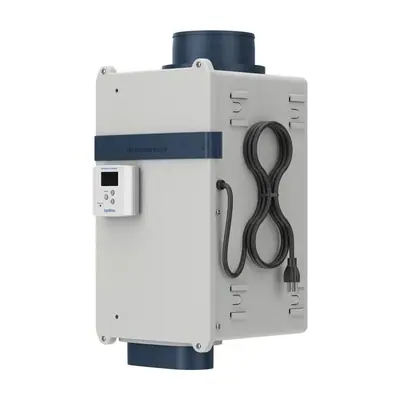
    AprilAire 8145 Fresh Air Ventilator

    Model 8145 / 8145NC

    Locks out ventilation during the hottest and coldest times and compensates later with additional fresh air (8145). Adjustable high/low outdoor temperature and indoor RH limits.

    View details

Compare all indoor air quality from every brand

Balance humidity too, with a humidifier for winter or a dehumidifier for summer.

What to expect

How a new air quality installation works

  1. Free in-home assessment

    We look at your home, your current system and your comfort goals. Quotes are free and no-obligation.

  2. Right-sized recommendations

    We size the system for your home and walk you through standard, mid-range and premium options from every brand we carry.

  3. Clear written quote

    You get an itemized quote, plus help with available rebates and Financeit financing.

  4. Professional installation

    Our licensed installers handle the equipment, venting, gas and ductwork connections, then test everything and clean up.

  5. Warranty and maintenance

    We explain your manufacturer warranty and how annual maintenance keeps it valid.

Helpful guides

Whole-home ventilator questions

What's the difference between an HRV and an ERV?

Both exchange stale indoor air for fresh outdoor air through a core that recovers heat, and an ERV also transfers moisture. In winter, an HRV sends indoor moisture outside with the stale air, which helps dry out a home that's too humid. An ERV keeps more of that moisture inside, and in summer it limits how much outdoor humidity comes in. Both use balanced fans, so the same amount of air comes in as goes out.

Which is better for an Ontario home, an HRV or an ERV?

Either can work well in southern Ontario; the right choice depends on your home. An HRV is a common choice for homes that tend to be humid in winter, such as those with lots of occupants or window condensation. An ERV suits homes that get too dry in winter or too humid in summer. We'll look at your home's size, airtightness and humidity before recommending one.

Does the Ontario Building Code require mechanical ventilation?

Yes, new houses in Ontario must have a mechanical ventilation system that brings in fresh air and exhausts stale air, under Section 9.32 of the Ontario Building Code. In today's new homes, that system is commonly an HRV or ERV. Major renovations and additions can also bring ventilation requirements, so check with your municipal building department. If you're building or renovating, contact us to talk about your ventilation.

Why do new, airtight homes need a ventilator?

Because they don't leak enough air to refresh themselves. Older homes get fresh air through gaps and cracks, while well-sealed new homes trap moisture, cooking odours, chemicals from furniture and finishes, and carbon dioxide from the people inside. A ventilator replaces that air on purpose, through a filter, and recovers much of the heat so you aren't paying to heat cold outdoor air. It also helps control window condensation.

Can I add an HRV or ERV to an older home?

Yes. An HRV or ERV can be added to most homes, either connected to your furnace ductwork or with its own dedicated ducts. Older homes are leakier, but if you've upgraded windows, insulation or air sealing, or you have condensation, stale air or lingering odours, a ventilator can make a noticeable difference. We'll check your ductwork and recommend the simplest way to install one.

How often should I clean my HRV filters and core?

Clean or replace the filters every one to three months, and clean the core about twice a year. Natural Resources Canada recommends these intervals, along with checking the condensate drain every six months. Many filters can be vacuumed or washed, and many cores can be rinsed, but check your manual first. Dirty filters and cores cut airflow and efficiency. Turn off the power before servicing, and have the unit professionally serviced once a year.

Should my HRV run all the time?

In most homes, yes, on low speed, with a boost when you need it, such as when cooking, showering or entertaining. Continuous low-speed ventilation gives a steady supply of fresh air, while long periods off let moisture and odours build up. In winter, if your home feels too dry, turn the speed down rather than switching the unit off, and check that your humidifier is working.

Will a ventilator make my home cold in winter?

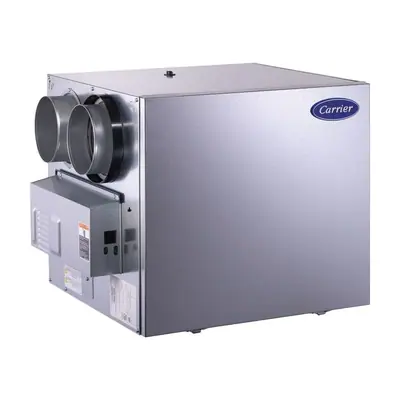
No, not noticeably. The core transfers heat from the outgoing stale air to the incoming fresh air, so much of the heat stays in your home; Carrier's Performance HRV, for example, is rated for up to 78 percent sensible recovery efficiency. The fresh air is usually delivered through your furnace ducts, where it mixes with house air. In very cold weather, the unit runs a defrost cycle to keep the core from freezing.

Can a ventilator help with window condensation?

Yes, in winter an HRV is one of the most effective fixes. It replaces moist indoor air with drier outdoor air, lowering indoor humidity and the risk of condensation on cold glass. Natural Resources Canada recommends keeping the HRV running and adjusting its dehumidistat during the heating season. Also keep blinds and drapes partly open so warm air reaches the windows, and make sure your humidifier isn't set too high.

Is an HRV the same as a bathroom fan or air purifier?

No. A bathroom or kitchen fan only exhausts air from one room, and the replacement air leaks in wherever it can, unheated and unfiltered. An air purifier cleans the air already in your home but doesn't bring in fresh air. A ventilator supplies filtered outdoor air and exhausts stale air in balance, while recovering heat. Many homes use all three: a ventilator, exhaust fans and good filtration.

Ask Us a Question

Financing for new home systems

Spread the cost with monthly payments

A new furnace, air conditioner, heat pump or water heater doesn't have to wait. Start saving on energy now and pay over time.

  1. Get your free, itemized quote
  2. Apply online with Financeit
  3. Choose a monthly plan that fits
Call now Book service